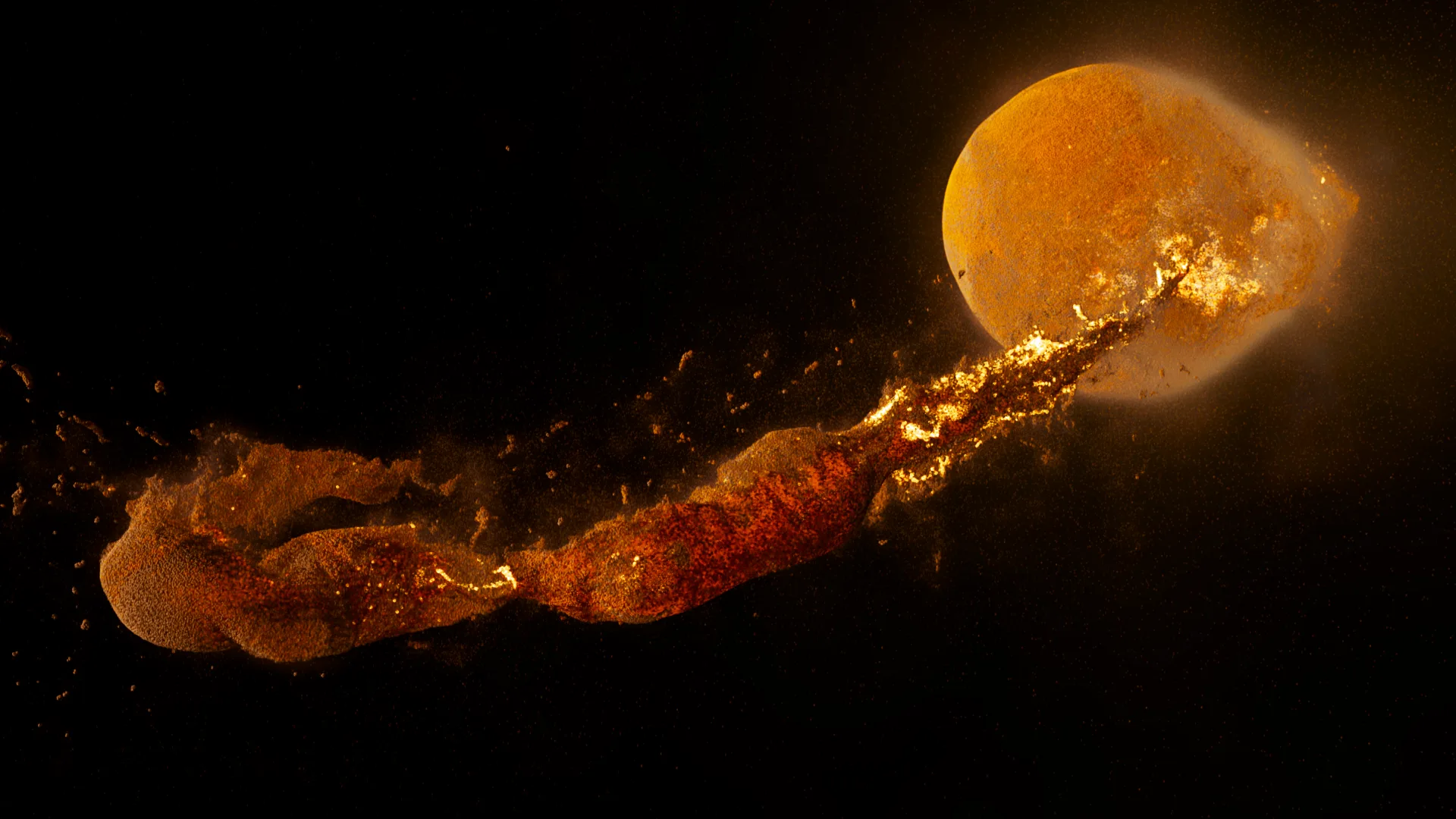
How do planets form?
Our solar system used to be a much more violent place, with early planets crashing into each other to create the worlds we see today.
Four and a half billion years ago, a colossal cloud of gas, dust, and ice started to collapse under its own gravity. In the centre, enough material clumped together at higher and higher pressures and temperatures to form the Sun -- mostly hydrogen, some helium, and small amounts of heavier elements. Around this star, hundreds of small "proto-"planets start to form in a disk, as lumps of rock and ice clump together into ever larger pieces.
Rocky planets like Earth were born as tens of these proto-planets crashed into each other in massive collisions called giant impacts.
Larger planets like Jupiter formed big enough cores to stop lighter elements like hydrogen from escaping their gravity, and grew rapidly into giant planets of mostly gas.
How do we study giant impacts?
Impacts between whole planets are far too large to test with full-scale experiements. So, we study these dramatic events using supercomputer simulations, calculating how planetary materials evolve at this scale of gravity and pressure forces.
Lab experiments are also important, to improve our models for how materials behave, and to test that our simulations are performing reliably.
Ongoing and future missions to the Moon, like Artemis, and complementary studies of Earth, continue to uncover more of the complicated shared history of the planet and its natural satellite. New measurements also reveal extra details for us to try and match with simulations, to rule out or discover new scenarios by testing what they can and can't explain.
The simulations we run use a common method called smoothed particle hydrodynamics, or SPH. SPH represents or models the planets with millions to billions of particles. With the computer, we calculate the gravity and pressure forces between every particle, to update their acceleration and movement. We then compute their new positions a small step in time in the future (typically less than a second), then recalculate the new forces, and repeat. We repeat this many times to simulate how the whole system evolves.
How did the Moon form?
Our Moon is big. Really big! At over 1% the mass of the Earth, it is dozens of times more massive -- as a fraction of the host planet -- than all other large moons in our solar system.
For example, Jupiter's moon Ganymede is the largest of all, at twice the mass of Earth's Moon, but is less than 0.01% the mass of Jupiter. Unlike ours, most of the giant planet's moons also formed along with the planet, kind of like the planets did around the Sun.
Instead, Earth's Moon is thought to have formed from a giant impact, near the end of the planet's main growth. The debris from the collision is sprayed out into a disk. The Moon would then slowly clump together out of the ejected material.
This is the best and perhaps only way to explain how a moon as big as ours could form around Earth. An impact could also neatly explain why the Moon has such a small iron core, because most of the impactor planet's core would sink into Earth.
However, several questions remain about exactly what kind of impact scenario is the best explanation for the origin of our Moon.
Can you make a Moon?!
See if you can choose the right parameters for an impact to make a debris disk with enough material and orbiting spin ("angular momentum") that a moon like ours could grow out of it. What speed, angle, and size of impactor works best? What happens if an impact is too gentle, or way too strong?
Can you find any special impacts in this set where a big moon forms immediately?
Using high-resolution simulations, we recently discovered that a range of impact scenarios can make a big moon directly, without first spreading out the material into a disk. This opens up new options for the Moon's origin and early evolution.