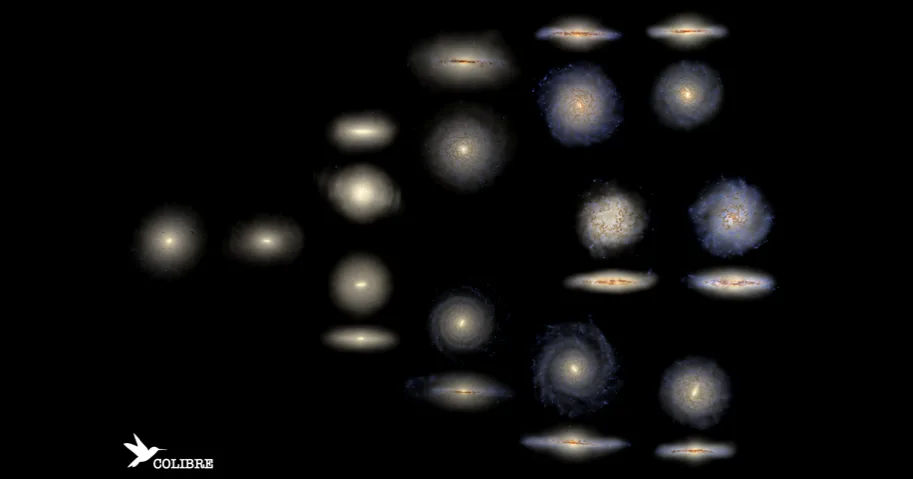
What shapes a Galaxy?
From the vantage point of our own galaxy, the Milky Way, powerful telescopes have revealed a stunning array of different galaxies dotted through the cosmos around us. We see examples from the grand, spiral structure of the Whirlpool galaxy, to the smooth glow of M31, and even the messy tangle of the Antennae galaxies. But why does this diversity come about?
The way a galaxy appears, or it's 'morphology', is a consequence of how it has come together - and studying it can tell us a lot about how they form and evolve. Galaxy formation is a balance; gravity attracts material onto galaxies, gas can cool to form stars and explosive energy released by supernovae and super-massive black holes can drive material back out again. What's more, galaxies can interact, stirring each other up or even dramatically merging together. These different processes can act together across billions of years, but we can only ever observe galaxies for a snapshot of their lives. By trying to decode how galaxies appear to us, we can piece together the puzzle of galaxy formation.
Cosmic Beacons
Once referred to as 'Island Universes', Galaxies are self-contained systems of stars, gas, dust and the mysterious substance of 'dark matter'. These act like beacons in the distant Universe, illuminating the material in their environment, and marking of the cosmos, known as the "cosmic web" (see the Large Scale Structure and Cosmology!). A better understanding of galaxies helps us learn how the Universe is structured on the very largest scales.
A Box of Galaxies
With galaxy formation taking billions of years and across vast distances, the closest we can get to experimenting with galaxy formation is to build powerful computer models. With the power of modern super-computers, billions of years can be sped up to as little as a few days. These simulations follow how a portion of the Universe evolves from the dawn of time to the present day. By spreading the calculation onto thousands of CPUs at once, we can follow a whole population of galaxies and see if we can reproduce the diversity of the real galaxy population.
The Galaxy Formation Machine
Want to build your own galaxy? During the Royal Society Summer Science Exhibition you can try out our galaxy formation machine. By choosing a candidate galaxy from its characteristics very early in its life, we use simulations to follow how it evolves through time. See and hear how important processes, like the rate of stars forming or the rate at which matter falls onto the central black hole, compete to produce your final galaxy. Can you form a swirling spiral? Or an unassuming elliptical? Perhaps even a galaxy just like our home, the Milky Way.