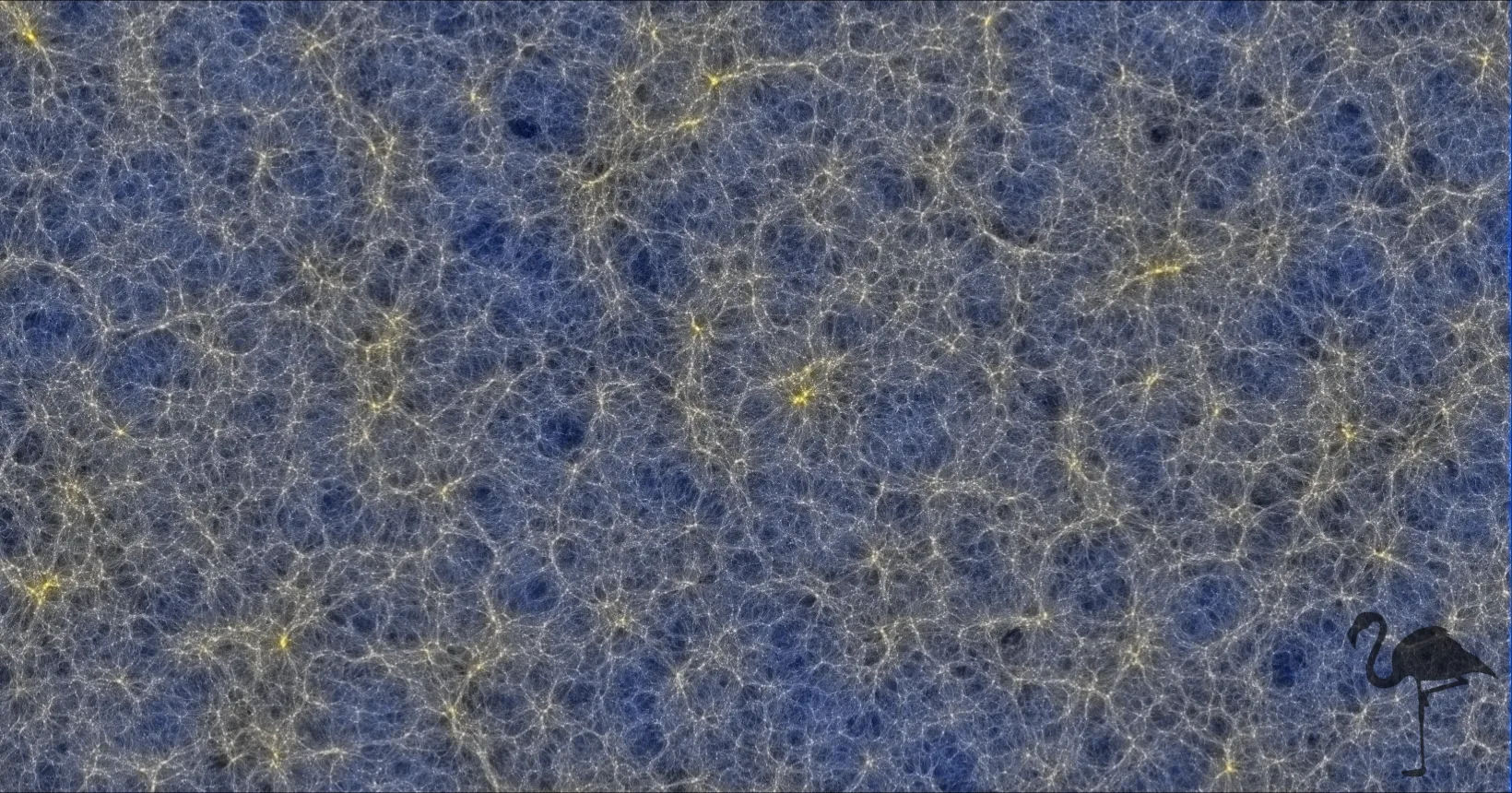
What is the cosmic web?
On the largest scales, the Universe is not spread out evenly. Galaxies gather into a vast network called the cosmic web, with long filaments, dense clusters, thin sheets, and enormous empty regions known as voids. This structure is underpinned by a skeleton of dark matter, an invisible form of matter whose gravity pulls ordinary matter, gas, stars, and galaxies into place.
Immediately following the Big Bang, the Universe appears almost uniform, but, importantly, not completely uniform. This slight departure from uniformity (or homogeneity if you like) provides the seeds from which the cosmic web grows. Over billions of years, gravity amplified those small ripples: denser regions attracted more matter and grew into galaxies and clusters, while emptier regions became larger voids. The web is still evolving today as galaxies move, merge, and form along its structure.
Why do we study it?
The cosmic web is a fossil record of how the Universe grew. By measuring its shape, size, and evolution, we can test theories about the fundamental rules underpinning our Universe, including the laws that govern the evolution of dark matter, dark energy, gravity, and the conditions in the early Universe. These are some of the biggest open questions in modern cosmology.
However, it isn't just cosmology that we can learn about by studying the largest scales. So-called "large scale structure" (LSS) also helps us study galaxies on much smaller scales. In particular, we can dig into the secrets controlling the diversity of galaxies we observe across the age of the Universe. A galaxy's place in the web (its "environment") can affect how much gas it receives, how often it interacts with neighbours, and how quickly it forms new stars. Studying the web allows us to connect the largest scales in the Universe to the lives of individual galaxies and, by extension, the stars and planets that form within them.
How do we study it?
Unlike many other fields, we can't create the Cosmic Web in a laboratory, poke it with a stick and see how it reacts. Not only are the spatial scales beyond human comprehension; the timescales over which the Cosmic Web evolves are distinctly non-human too. Instead, we confine the uncountable light-years and billions of years encompassed by the Universe's evolution into computer codes where we can play God with fundamental physics and watch the Universe evolve before our eyes. However, with only these virtual universes to study, we can't say for certain which version of our physical laws and which ingredients are correct. To truly lock down the physics at the root of everything, we need to compare our simulations with real observations from telescopes probing the Universe across the electromagnetic spectrum, from radio waves to gamma rays.
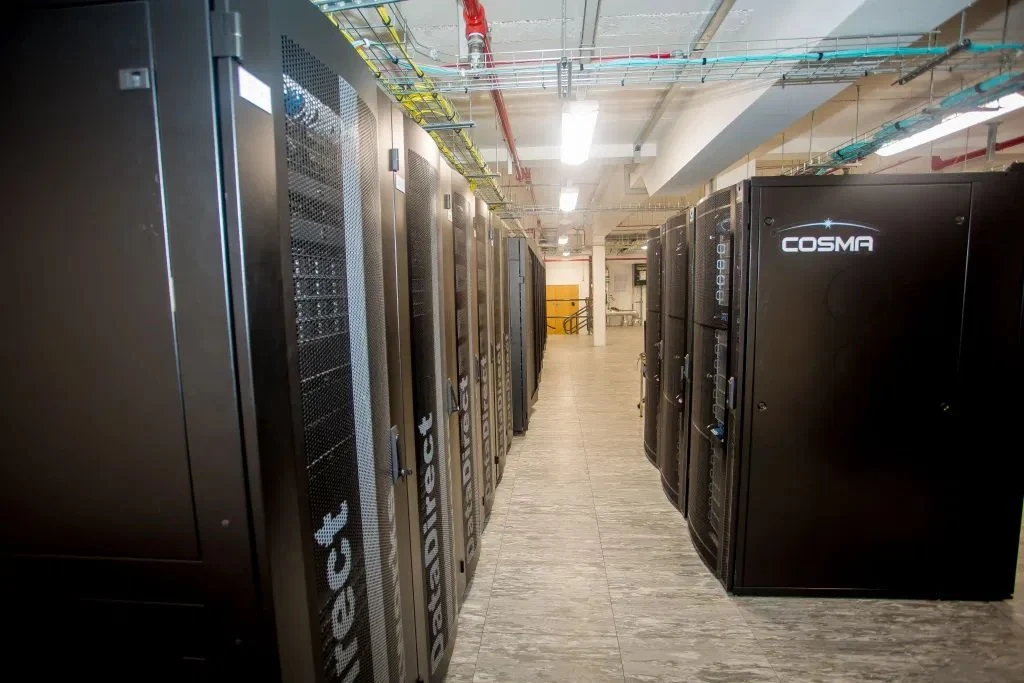
COSMA is Durham University's memory-intensive DiRAC supercomputer for cosmology, astrophysics, and particle physics research. Credit: Durham University.
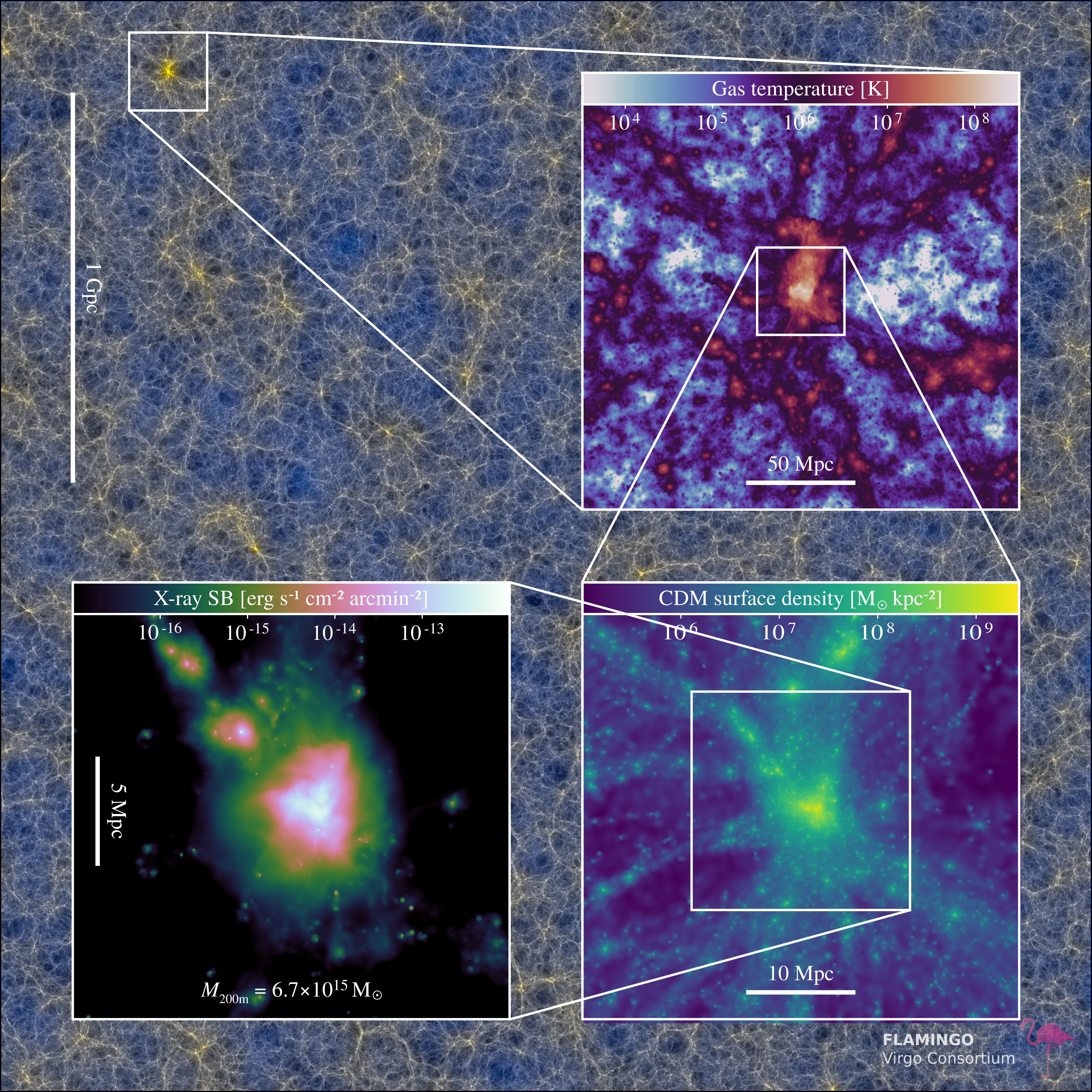
FLAMINGO simulation visualisation from Schaye et al. 2023. Credit: FLAMINGO.
In the codes used to simulate the Universe, we start from the tiny ripples left over from the early Universe and then let computational descriptions of physical processes take control, from gravity through to the laws governing the growth of supermassive black holes and the deaths of stars. Under these descriptions, dark matter collapses into the backbone of the web, gas falls into that backbone, stars form and cause galaxies to light up, and clusters, filaments, and voids emerge naturally from the calculation. Because the Universe inside the computer is under our control, we can freely turn different pieces of physics up, down, on, or off and see which ingredients are needed to make something that looks like reality.
Once we have our virtual universes in hand, we hold them up against the real one via wide-area galaxy surveys (including the surveys from the Euclid Space Telescope, the Dark Energy Spectroscopic Instrument, and, in the coming years, the Vera Rubin Telescope and Nancy Roman Space Telescope, amongst many others). Galaxy surveys map the positions, distances, colours, and motions of millions of galaxies, while other telescopes reveal hot gas, galaxy clusters, and the subtle bending of light caused by dark matter. When simulations and observations agree, we gain confidence that we are capturing the right physics; when they do not, the mismatch points us towards the places where our models, measurements, or even our ideas about the Universe need to improve.
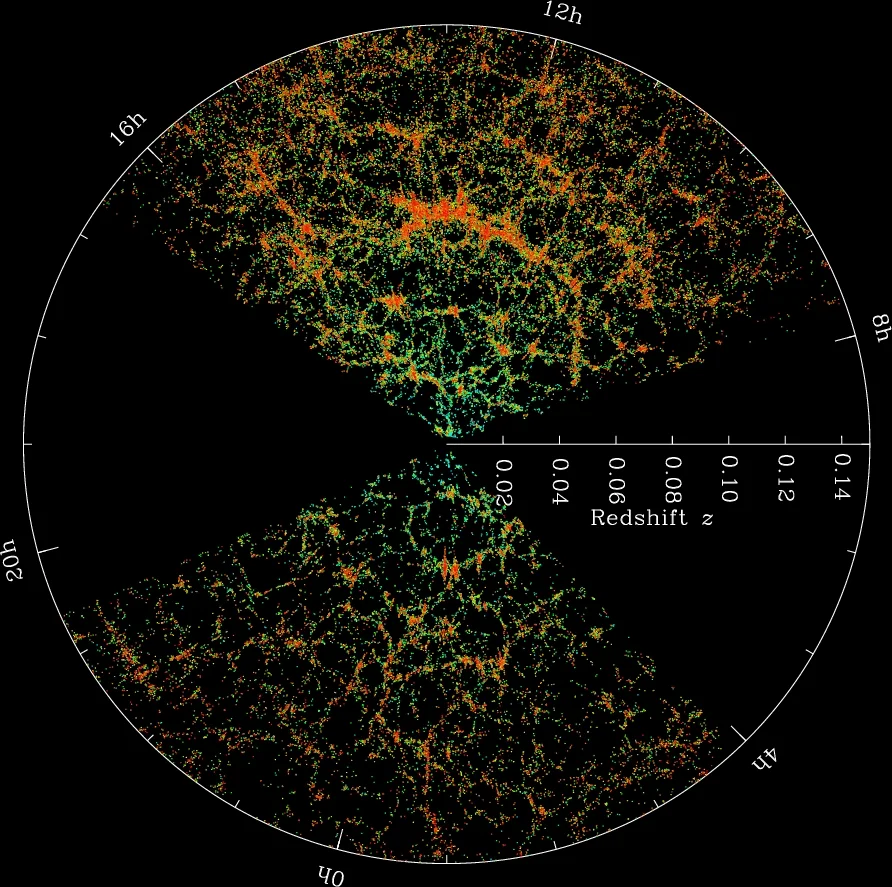
Galaxy map from the Sloan Digital Sky Survey. Credit: SDSS.
Make your own Universe!
During the Royal Society Summer Science Exhibition you will be able to join us in exploring the physical laws that underpin reality and choose your own physical properties to simulate your own virtual universe. But if you can't join us in person, fear not, we will be sharing the fun online too (link to Universe Engine coming soon!). Can you create a Universe that looks like our own? Or will you create a Universe that is completely different? The choice is yours!